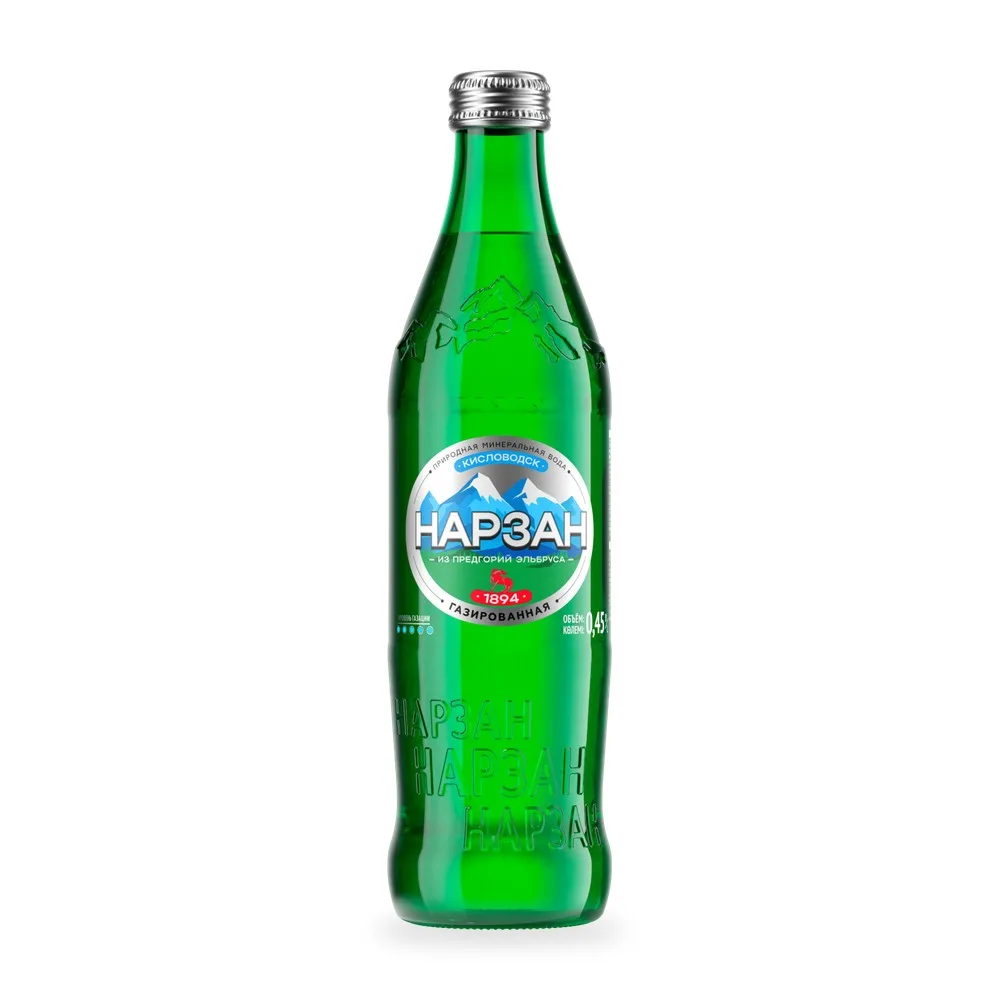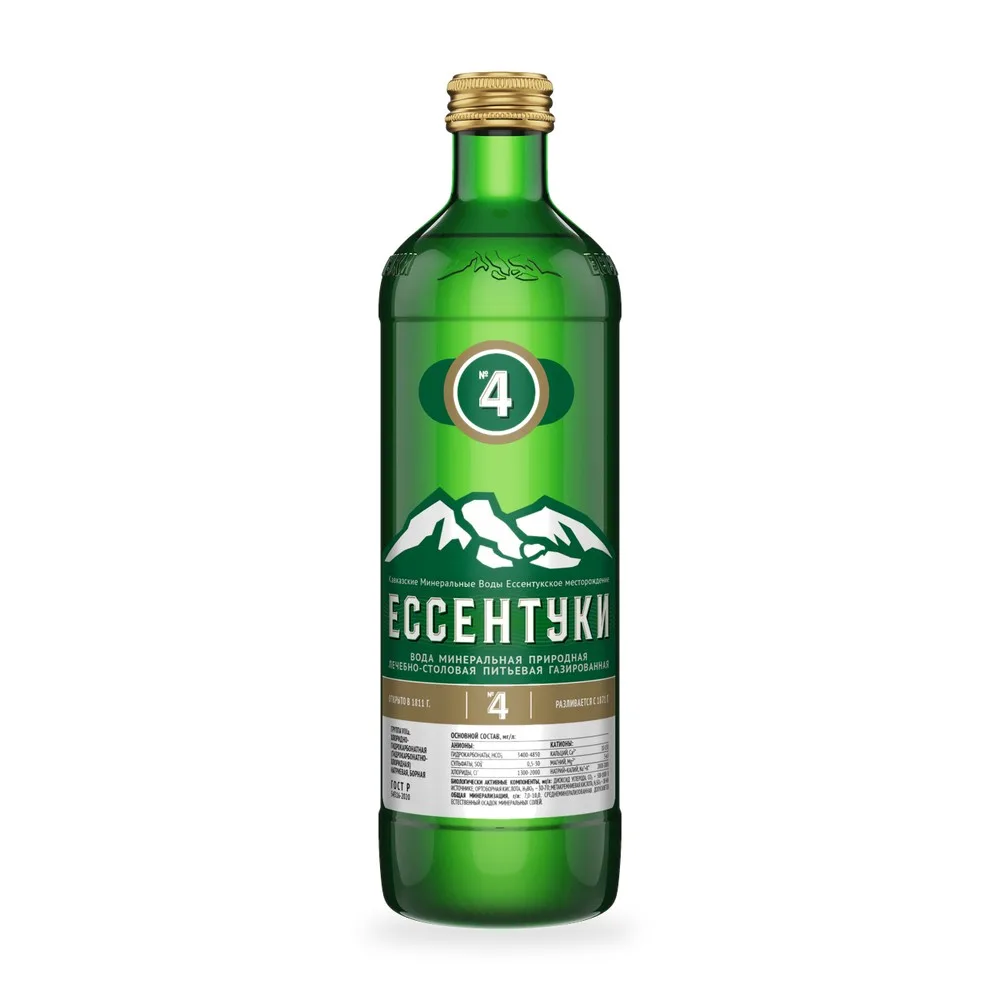
sparkling
Essentuki No. 4 0.45 L2,090 ฿for 20 pcs
105 ฿ per bottle
Composition and health · 7 min · 17 September 2026
How ionic names like "bicarbonate-chloride sodium" are formed, with Essentuki No. 4 and Narzan as examples.
In short: the type of a mineral water is named after the main anions and cations, the ones that account for more than 20% in equivalent terms. The ion listed first is the one there is less of, and the last one named is the most abundant. Under GOST R 54316-2020, Essentuki No. 4 is a chloride-bicarbonate sodium boric water. The same standard makes Narzan a sulphate-bicarbonate polycationic water with natural carbonation.
The anions come first, bicarbonates, sulphates and chlorides, then the cations, calcium, magnesium and sodium. Only ions that account for more than 20% in equivalent terms make it into the name, that is, more than a fifth of the total. The order runs from the smaller share to the larger, so "chloride-bicarbonate" means there is more bicarbonate than chloride. A second version of the order is often given in brackets: it is the same water, the batches simply vary a little. Special components and the type of carbonation are added at the end.
You can taste every anion. A bicarbonate water is soft, with a faint alkaline note: the EU threshold is more than 600 mg/L of HCO₃. A chloride water is salty, with a threshold of 200 mg/L of Cl. A sulphate water carries a bitter edge, also from 200 mg/L of SO₄. Pure types are rare: most names carry two or three anions at once, as with Essentuki No. 4 and Narzan.
Cations shape both the taste and what the water brings to the body. Under EU rules a water is calcic from 150 mg/L of calcium, magnesic from 50 mg/L of magnesium and sodic from 200 mg/L of sodium. A sodic water is recognisable at once by its salty note, a magnesic one by its bitterness. When no single cation dominates and calcium, magnesium and sodium all take a noticeable share, the water is called polycationic, which is exactly how GOST R 54316-2020 describes Narzan.
Under GOST R 54316-2020 this is group VIIIa: a chloride-bicarbonate sodium boric medicinal-table water. In equivalent terms it is 55-80% bicarbonate, 20-45% chloride and more than 80% sodium with potassium. In mg/L on the label: HCO₃ 3400-4850, Cl 1300-2000, Na + K 2000-3000, orthoboric acid 30-70. A mineralisation of 7-10 g/L makes it a medium-mineralised water. It tastes salty with a soft alkaline note, which is why it is drunk in small portions with food.
The same standard puts Narzan in group V: a sulphate-bicarbonate polycationic medicinal-table water with natural carbonation, of the Kislovodsk type. In equivalent terms it is 40-75% bicarbonate, 20-60% sulphate, 20-70% calcium and 10-50% magnesium. In mg/L on the label: HCO₃ 1000-1950, SO₄ 250-1100, Ca 200-600, Mg 50-180, Na + K 50-450. Mineralisation is 2-3.5 g/L. The taste is gentler than Essentuki, with bubbles and a light bitterness from the sulphate and magnesium.
According to the producer. Not a medical recommendation.