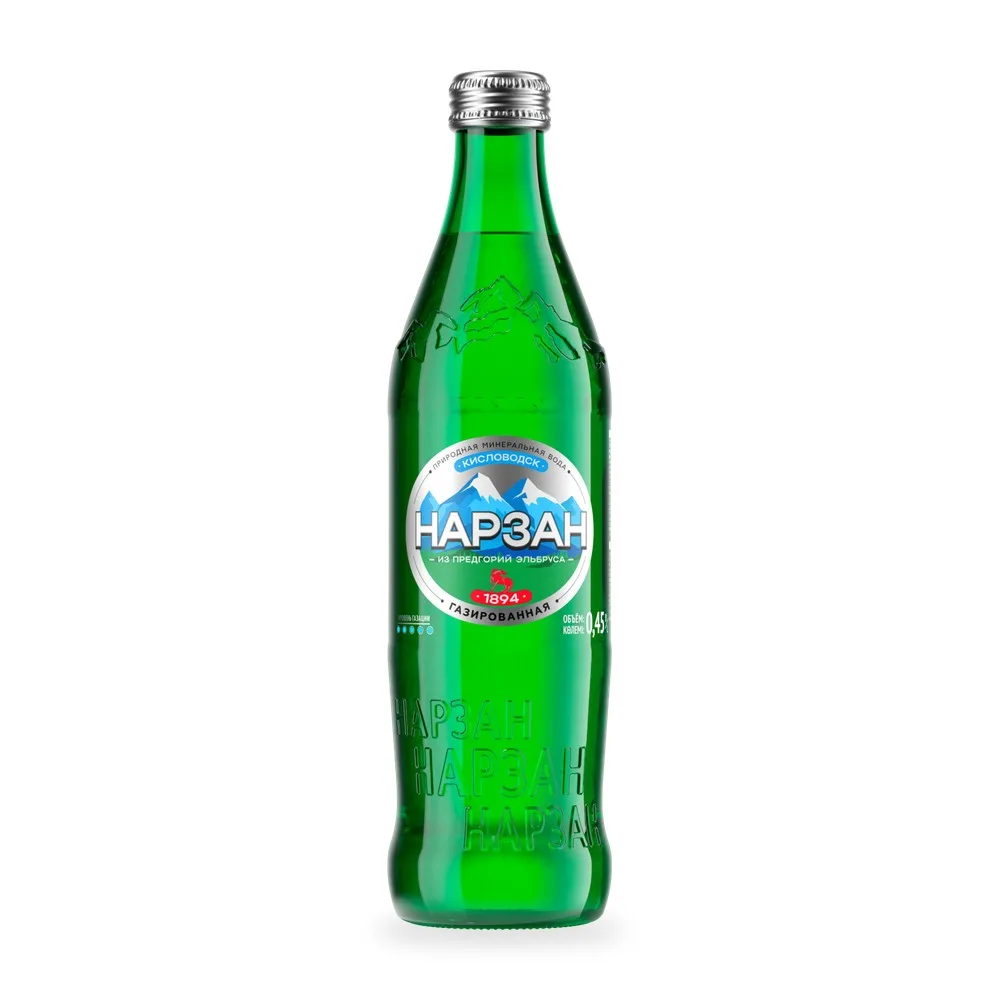
sparkling
Narzan 0.45 L1,520 ฿for 20 pcs
76 ฿ per bottle
Brand guides · 5 min · 17 September 2026
What natural carbonation means and how much calcium a litre of Narzan holds.
In short: Narzan is a sulphate-bicarbonate water, naturally carbonated, from the foothills of Mount Elbrus. Mineralisation runs 2–3.5 g/l, with a notable share of calcium and magnesium: 200–600 mg/l of calcium and 50–180 mg/l of magnesium according to the label.
The carbon dioxide gets into Narzan underground: the water travels through the rock of the Kislovodsk deposit and takes on gas while still in the aquifer. Analysis of 2023 batches puts free CO₂ at around 2.5 g/l, and GOST R 54316-2020 describes a water like this as naturally carbonated. That is where the prickle comes from, with no factory carbonation involved. To keep the gas in, keep the bottle closed and serve the water chilled to 8–12 °C.
Narzan is a sulphate-bicarbonate water with a mineralisation of 2–3.5 g/l. The label gives 200–600 mg of calcium, 50–180 mg of magnesium, 1,000–1,950 mg of bicarbonates and 250–1,100 mg of sulphates per litre; analysis of 2023 batches returned calcium at 361–381 mg/l and magnesium at 82–97 mg/l. Under EU rules a water may be called calcic from 150 mg/l of calcium and magnesic from 50 mg/l, and Narzan clears both thresholds. Sodium plus potassium stays modest: 50–450 mg/l.
Narzan's mineralisation is moderate for a medical table water, so it is served at the table and with food, usually a 150–250 ml glass up to three times a day. After the banya or a workout it is useful because it returns not only water but part of the calcium and magnesium lost in sweat. It is not meant to be drunk by the litre in place of plain water: build the day's volume on table water instead. All of this comes from the producer and is not medical advice.