−10%
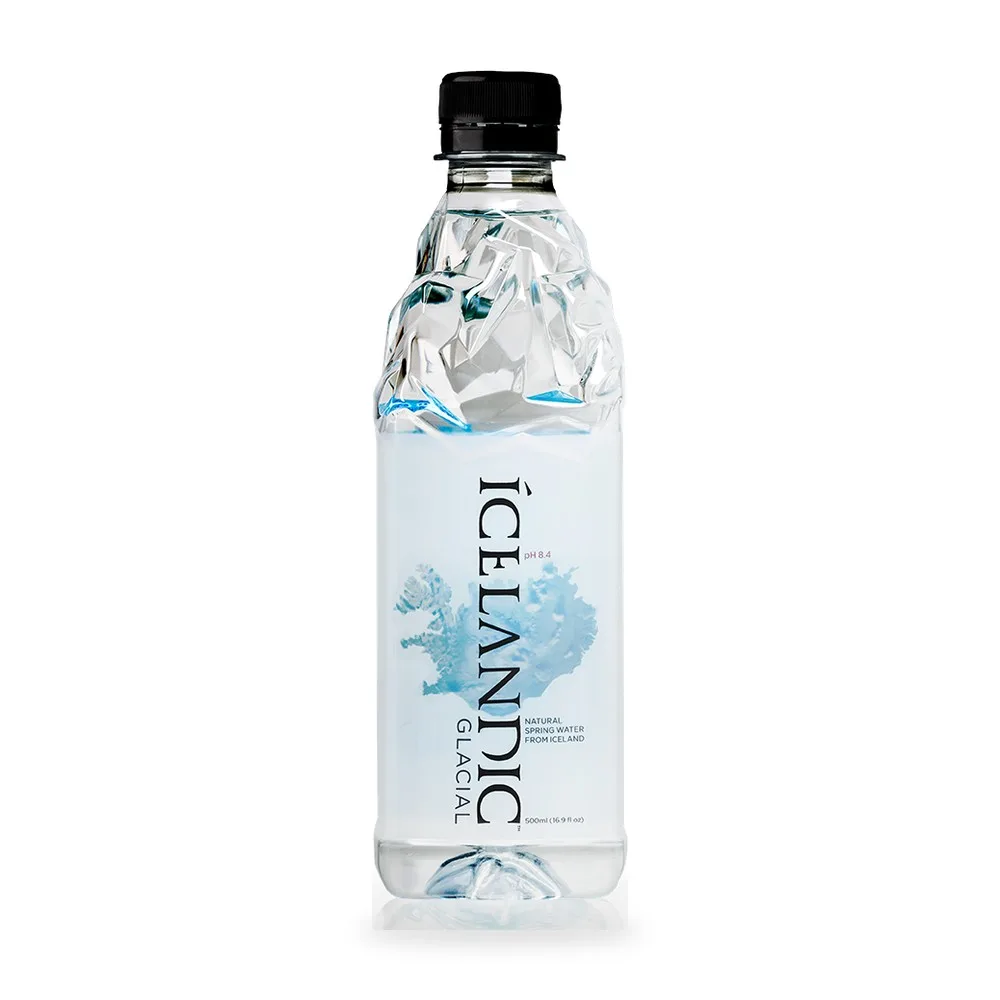
Icelandic Glacial 0.5 L1,370 ฿for 24 pcs
57 ฿ per bottle
Composition and health · 8 min · 17 September 2026
Main minerals and the limits for nitrate, fluoride, arsenic, boron and lead under WHO, EU, Russian and Thai rules.
In short: good water contains calcium, magnesium, bicarbonates and a little sodium, and how much of each depends on the source. Everything beyond that is capped by regulation. Arsenic and lead are limited to 0.01 mg/L, nitrate to 45-50 mg/L, and fluoride in bottled water in Thailand to 0.7 mg/L. Mineral waters follow separate rules, so you cannot judge them and tap water by the same table.
Water with no minerals is distilled water, and it tastes flat. A normal composition rests on six ions, and their sum is the mineralisation: 62 mg/L in Icelandic Glacial according to the brand, up to 500 mg/L for water in 18.9 L bottles under the Thai standard, and 7-10 g/L in Essentuki No. 4. Limits on the minerals themselves exist for the sake of taste, not safety: Russian rules cap chloride at 350 mg/L and sulphate at 500 mg/L, while the WHO sets no limit for them at all.
These two lines say nothing about taste; they tell you how clean the source is, because nitrate arrives from fields and run-off rather than from the rock. The limits are close to one another almost everywhere: 50 mg/L for the WHO, the EU and Thailand, and 45 mg/L in the Russian SanPiN, and in protected groundwater the figures are usually several times lower. Nitrite varies more: 3 mg/L for the WHO, the SanPiN and Thailand, against 0.5 mg/L for EU tap water and 0.1 mg/L for natural mineral water.
These four substances are tested in every batch, and their limits are the tightest of all. Arsenic and lead are capped at 0.01 mg/L almost everywhere, and from 12 January 2036 the EU halves lead to 0.005 mg/L. The general fluoride limit is 1.5 mg/L, but hot climates bring it down: Thailand sets 0.7 mg/L for bottled water, and the Russian rules set the same 0.7 mg/L for the hottest climate zone, where people drink more. Boron is the one line where the limits differ fivefold, from 0.5 mg/L in the SanPiN to 2.4 mg/L at the WHO.
You cannot judge mineral water and tap water by the same table. Mineral water is drawn from deep protected wells and is not stripped down to nothing: its natural composition is exactly what people buy it for. That is why the EU gives it a separate set of rules, Directive 2003/40, which allows up to 5 mg/L of fluoride but only 0.1 mg/L of nitrite. Above 1.5 mg/L of fluoride the label has to say so, because that water is not given regularly to children under 7. Thailand's Notification No. 462 does not cover natural mineral waters either.
Three steps that take a minute at the shelf. First, the water type and the mineralisation: together they tell you straight away whether this is table water or medicinal-table water. Second, the ion table in mg/L, which you will find both on Narzan and on the Thai sticker of Essentuki No. 4. Third, the Thai FDA registration number, without which the water is best left where it is. Nitrate, fluoride and arsenic are usually missing from that table: the full batch analysis is something you ask the seller for, and an importer holds one for every shipment.
According to the producer. Not a medical recommendation.